http://i78.photobucket.com/albums/j110/abc-goatswebsite/DSCF4935.jpg
Let me see if I can explain what I'm looking at when I evaluate kits.
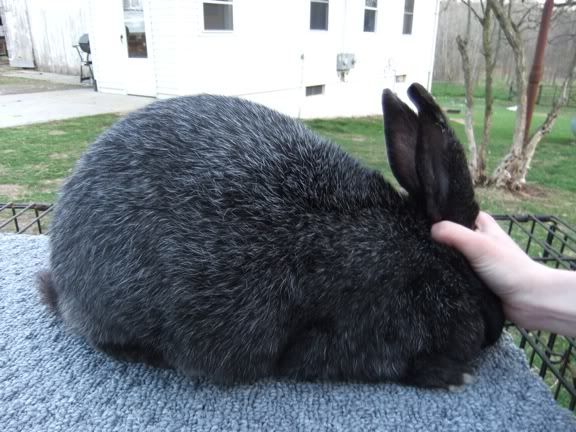
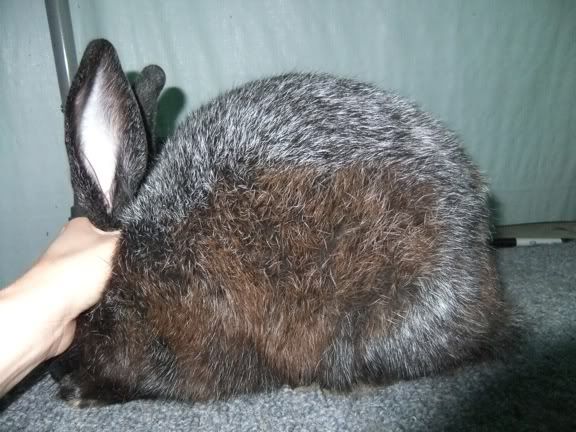
First they have to be posed properly. Their front toes should be directly under their eyes - not posed like superman and not bunched up so that their elbows are in the air. Their elbows shoudl sit on the table surface. Their back toes should sit directly under the highest point over their back. If their peak (highest point of body curvature) is before their toes, they're called 'early' in peak. If the peak is after their toes, they're 'late' in peak.
The shoulders should rise immediately as possible after the neck. The shape should be rounded with NO flatness over the top OR in hinquarters.
This is a doe who has long, low shoulders. Notice that the rise of her shoulders is really slow:
Of course, the profile view gives you no information about their width. This is evaluated from the top while posed - you want to see a nice hindquarter that looks like a big C - rounded and wedging a little to balence well with the shoulders and front end of the animal. You don't want their hindquarters to look like a V, where the body narrows to the hindquarters. I evaluate this by looking at them as well as feeling how far apart the hocks are - a narrow animal's hocks will be very close together ahwere you veel them as they are posed, whereas a wider animals's hocks will be farther apart.
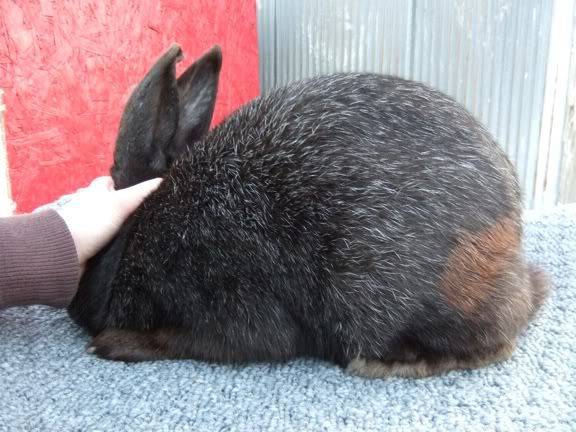
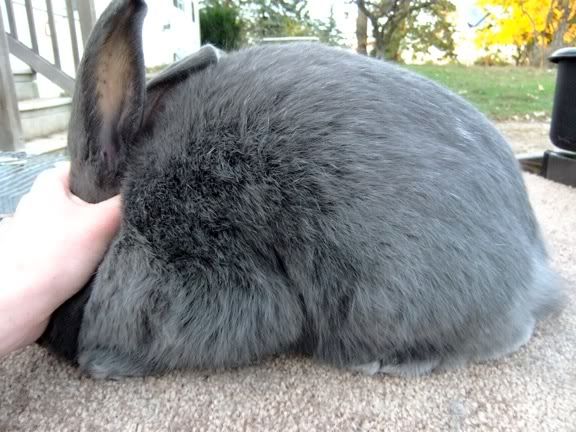
Here's an example of 'chopped hindquarters', which is where their roundess of body curves over the top but then goes straight down to the table with no roundess to those hindquarters from a side view:
Here is an example of a bun that peaks early. Generally with these you will also see levelness instead of the desired roundness. Instead of having a nice rounded shape, the peak is reached quickly, then it's a straight line down to the hindquarters. This one is't the worst I've ever seen, as you see the levelness doesn't continue all the way to the HQ'rs, but it's obviously not desired.

Thirdly, FUR is very important especially with Silver Fox. That fur MUST stand. Texture is to have little resilience, while showing density, deep/good color, and of course silvering. The length is ideally 1.5". Some people argue EVENNESS of silvering is more important, where others argue density of silvering (wether light or heavy - or the ideal medium) is more important. To me, I'll keep 'em if I like 'em enough.
Two comparible kits are tossed on the scale and the bigger usually wins out.
To be a 'keeper', they've gotta hit 4.5lbs by 10 weeks. I don't think I've ever kept anything smaller so far.
First and foremost this breed is a MEAT breed. I love that my culls fill my freezer for me. With such a small rabbitry (12 doe cages, 8 buck/jr stock cages, and one growout pen), I get to be really picky about who stays/goes. With all these upcoming youngsters, I might actually be looking to cull some of these adult rabbits I own...

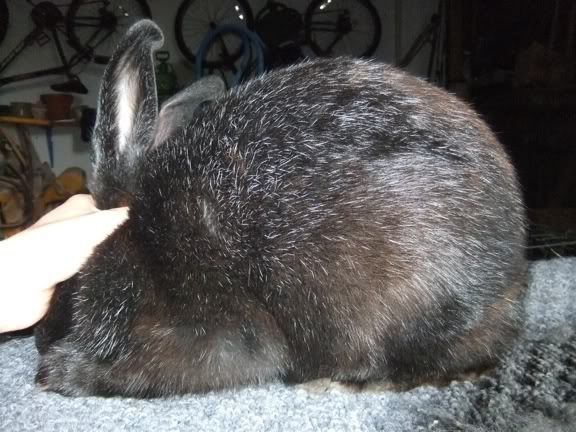




 What do you look for in pictures like this?

 I also think Wren is the prettiest.